


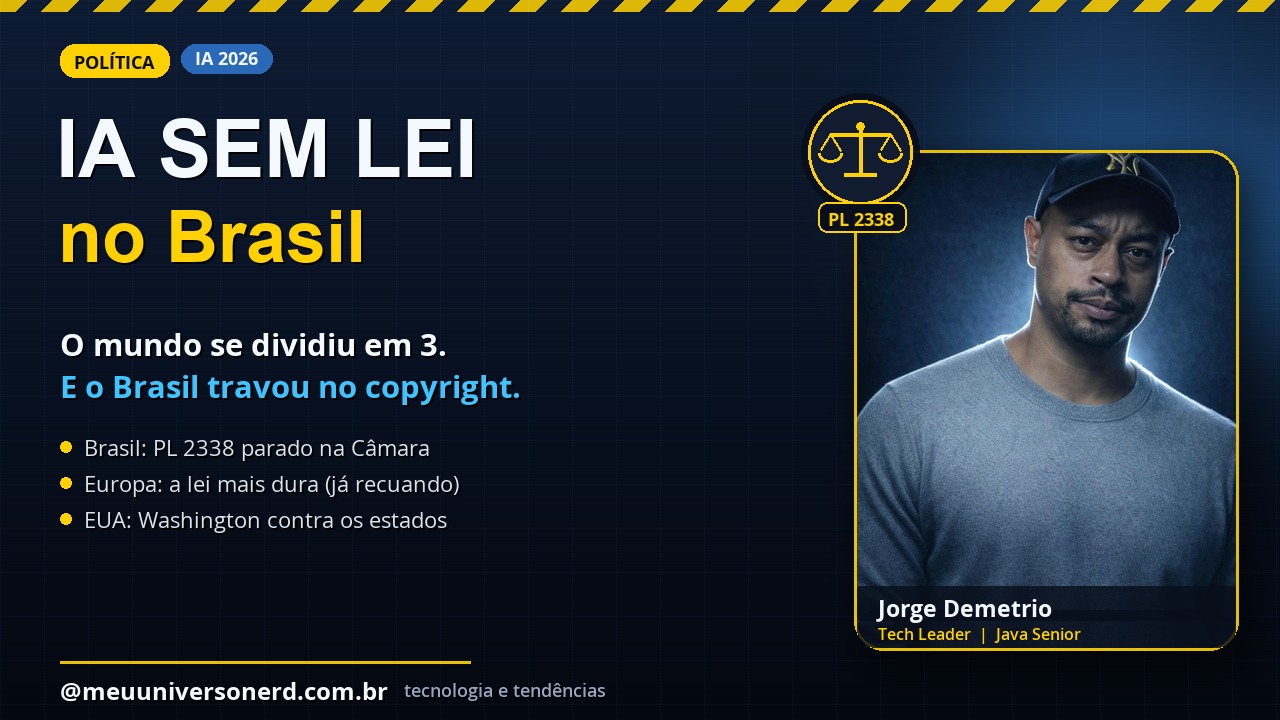
You open ChatGPT to fix a bug, ask Gemini for a summary, generate an image and move on with your day. Honest question: is there any law in Brazil saying what these tools can and cannot do with your data, your work, your face? The answer, in June 2026, is still no. There is a bill, already passed by the Senate, but it has been stuck in the lower house for over a year.
While Brazil debates, the rest of the world has already split into three very different paths. Europe wrote the toughest law on the planet and is now walking part of it back. The United States went the opposite way and is in an internal war between the federal government and the states. And Brazil sits in the middle, with a text that copies the European model but got stuck on a single point: copyright. Let's understand where each one stands, without legalese, and what it changes for those who use and those who build AI.
First, the basics: a law, a bill and an executive order are not the same thing
Before claiming that "this country regulated AI", it helps to separate three things the news tends to blend, because they carry very different weight.
- A law in force: it passed the legislature, was signed and already binds everyone. Break it and you pay a fine. That is the European case.
- A bill: it is a proposal. It can be stuck, it can change entirely before becoming law, it may never pass. That is Brazil's case.
- An executive order: it is the president telling the government to act a certain way, without going through Congress. It lasts as long as the term and can be struck down in court. That is the main instrument in the United States today.
Hold on to that distinction, because it is the difference between "there is a rule actually in force" and "there are people arguing about a rule". Now we can look at each block clearly.
Brazil: bill PL 2338 is ready on paper, but stuck in practice
Brazil chose the path of a broad law, similar to the European one. The text is called PL 2338/2023, nicknamed the AI Legal Framework. It was approved by the Senate in December 2024 and sent to the lower house in March 2025. So far, on track. The problem is what came next: nothing.
In the lower house, the bill landed in a Special Committee chaired by congresswoman Luisa Canziani, with congressman Aguinaldo Ribeiro as rapporteur. He was appointed in May 2025 and, by the end of June 2026, has still not delivered his report. The bill officially remains "awaiting the rapporteur's report" while it piles up other bills attached to it. The vote was promised for early 2026, then pushed back, and the most recent signals already talk about leaving it for the end of the year.
What the text proposes is much like the European risk classification model:
- Excessive risk: banned uses, such as autonomous weapons and certain forms of manipulation or social scoring.
- High risk: systems in sensitive areas (credit, HR, health, public safety) with stronger duties, impact assessment and human oversight.
- Rights of the affected person: the right to information, to an explanation of an automated decision, to contest it and to ask for human review.
- Fines: administrative penalties of up to R$ 50 million per violation.
To coordinate all this, the bill creates a National AI governance system, with the ANPD (the same authority behind Brazil's data protection law) in a central role. The federal government also tabled its own bill, PL 6237/2025, drafted alongside the rapporteur, creating a Brazilian AI Council and a national system, with the ANPD as the regulator where there is no sector-specific rule. In other words: there is a text, there is an institutional design, there is a government pushing. There just is no vote.
So why is it stuck? The knot is called copyright
The point that holds PL 2338 back the most is not risk, nor fines. It is copyright. The fight is over a question that is expensive for anyone who creates content: can a company train an AI model using protected texts, music, photos and code, without paying and without asking? And if it can, does the original author have a right to any payment?
On one side, the tech sector wants light rules so as not to slow down model training. On the other, artists, journalists, musicians and civil society want transparency about what went into training and some kind of payment. This deadlock is not just Brazilian. It is, right now, the most explosive AI debate in the whole world, and that is exactly why it stalls our law. I will come back to it shortly, because it connects everything.
Europe: the toughest law in the world (that started to back off)
The European Union moved first. The EU AI Act entered into force in August 2024 and is the first broad AI law on the planet, also risk-based. It does not apply all at once, it switches on in phases:
| When | What starts to apply |
|---|---|
| Feb 2025 | Banned AI uses (unacceptable risk) |
| Aug 2025 | Rules for general-purpose AI (the large models), with transparency and copyright |
| 2 Aug 2026 | Transparency for AI-generated content and power to supervise and fine the large models |
| 2027 / 2028 | Full obligations for high-risk systems (after the 2026 delay) |
The fines are scary: up to 35 million euros or 7% of global turnover, whichever is higher. But in 2026 a twist few expected happened. Under pressure from big tech and from part of European industry itself, in May the EU passed a package nicknamed the "Digital Omnibus" that postponed the high-risk deadlines, pushing much of them from 2026 to 2027 and 2028. The 2 August 2026 date still stands for transparency and for supervising the large models, but the political message was clear: not even Europe, which wrote the strictest law, is comfortable applying all of it on time.
United States: the opposite path, and an internal war
If Europe tightened, the United States made a point of loosening. Early in 2025, President Trump revoked the previous administration's AI executive order and signed his own, focused on removing barriers and securing American "leadership" in AI. In July 2025 came America's AI Action Plan, a pro-innovation and pro-export package.
Here is the most curious part, and it should fascinate anyone who likes understanding distributed systems: the US has no federal AI law, and it turned into a tug of war between Washington and the states. Congress tried to pass a moratorium that would ban states from making their own AI laws, and the moratorium failed. Without it, in December 2025 Trump signed an executive order creating a task force at the Department of Justice to sue states with "onerous" AI laws and threatening to cut federal funding from those who insist. On the other side, states such as California (a training-data transparency law in force since January 2026) and Colorado keep legislating on their own. It is a live federation fight, with AI in the middle.
China, ISO and the rest: the world is not standing still
Beyond that trio, the game moves too. China made mandatory, since September 2025, the labelling of all AI-generated content, and folded AI into its new Cybersecurity Law, in force since January 2026. It is the most control-first model among the big players.
For anyone working with technology inside a company, there is a practical detail that matters more than any national law right now: the ISO/IEC 42001 standard, the first international AI management certification. It is voluntary, but it has already become a contract and audit requirement, the same way ISO 27001 did in the security world. Add the UNESCO Recommendation on the Ethics of AI, signed by nearly 200 countries, and you get a common governance floor that exists whether or not your country has a law.
The knot that connects everything: copyright
Remember I said copyright was stalling Brazil? Well, it is the same knot for the whole world, except elsewhere the fight already reached the courts and with eye-watering numbers. Anthropic, the maker of Claude, settled for 1.5 billion dollars with authors after a ruling that treated "training on books" and "storing pirated copies" differently. In early 2026, record labels filed a 3.1 billion dollar suit against the same company. And there are similar cases targeting OpenAI, Google and others.
The message is direct: the question of "who owns the data that trains the model" stopped being philosophy and became a billion-dollar bill. As a Tech Leader, I look at this and think of the obvious thing few mention: the next competitive edge in AI may not be the smartest model, but having the legal right to use the data it learned from. Whoever trained on things they should not have will carry a hidden liability on the books.
And what changes for you, who use and who build AI
We can move past "Brazil still has no law" and look at what already affects you today, even with no Brazilian law on the air:
- If you only use AI at work: the hot topic is transparency. Knowing whether content was AI-generated and being able to contest an automated decision (credit, HR) are rights already in the European and Brazilian texts, and they become best practice even before they are mandatory.
- If you are a creator (text, music, art, code): the copyright debate is yours. Keep an eye on the rules about payment and training transparency, because that is where it is decided whether your work can be used for free to train a model.
- If you build or run AI systems: the European law has extraterritorial reach. If your product serves users in Europe, you fall under their rules, even running from Brazil. And ISO 42001 becomes the concrete way to show governance to a client and an auditor before any Brazilian law exists.
In other words: waiting for the Brazilian law to come out before you start worrying is the wrong move. The rules that already reach you come from abroad and from technical standards, not from the official gazette.
Frequently asked questions
Does Brazil have an artificial intelligence law?
No, not yet. Brazil has a bill, PL 2338/2023, approved by the Senate in December 2024 and going through the lower house since March 2025. It has not been voted on in the lower house and is therefore not law.
Why is PL 2338 stuck?
The main deadlock is copyright, the use of protected works to train AI models and the payment of authors. Governance is debated too. The rapporteur has not delivered his report, and the vote kept being postponed through 2026.
What is the EU AI Act and why does it affect me in Brazil?
It is the European Union's AI law, the first broad one in the world, risk-based. It has extraterritorial reach: if your system serves users in Europe, you must comply with their rules, regardless of where the company is.
Did the United States regulate AI?
Not with a broad federal law. The current policy is deregulation, driven by executive orders, and there is an open conflict between the federal government, which wants to block state laws, and the states, which keep legislating.
Is there a standard my company can adopt right now?
Yes. ISO/IEC 42001 is the first certifiable international AI management standard. It is voluntary, but it is already used as proof of governance in contracts and audits, even where there is no law.
The calendar to watch
- Brazil: the rapporteur's report on PL 2338 in the lower house. Until it comes out, there is no vote and no law.
- Europe: 2 August 2026, when transparency for AI-generated content and the power to fine the large models kick in.
- United States: the court decisions on the executive order trying to strike down state laws, and the billion-dollar copyright cases.
In the end, 2026 showed that regulating AI is harder than it looked, even for those who moved first. Europe backed off, the US fights internally and Brazil got stuck on the same point that stalls the world. The only certainty is that ignoring the topic stopped being an option, for the state, for companies and for developers.
And you, do you think Brazil should rush to pass PL 2338 or wait to get the copyright part right? Tell us in the comments, this debate has a long way to go.
Around here we talk about AI from the side of the people writing the code. If you like the topic, see how generative AI is entering Java development, how to connect AI agents to real tools with Java and MCP and today's other piece, on the AI that already decides the calls at the 2026 World Cup. Sources: Brazilian Senate, Chamber of Deputies and European Commission.