



🏟️ The 4 Hidden Technologies Entering the Brazil vs Japan Match
Monday, 2pm. You drop everything to watch Brazil face Japan in the round of 32, at NRG Stadium in Houston. The ball rolls, the crowd roars, and you would swear it is just football out there. It is not. There is a layer of engineering running on every play of that match, and most fans have no idea it is there.
The 2026 World Cup has become the biggest sports technology laboratory in history. We already opened the first part on the chipped ball and semi-automated offside, so this time I am going straight to four new technologies that will be on the pitch for Brazil vs Japan: the camera that knows who touched the ball last, the VAR that finally opens its black box to the whole stadium, your face becoming your ticket, and an audio and video codec making its streaming debut. Let us break down how each one works under the hood, because this exact vocabulary (computer vision, embeddings, codecs) is what shows up in developer interviews in today's market.

🕵️ Detecting deepfakes in Python: AI forensics for the 2026 elections
In March 2026 Brazil's electoral court (TSE) published Resolution 23.755, the first set of rules for artificial intelligence inside an election campaign: synthetic content must be labelled, deepfakes are banned in the final stretch of the vote, and anyone who breaks the rule faces fines from R$ 5,000 to R$ 30,000. By June the court had already logged complaints involving the use of AI. The bar moved, and it quietly turned into an engineering problem.
If you build any platform where media circulates, detecting synthetic content stopped being a curiosity and became a requirement. And the first step is the most counterintuitive one: stop trusting the human eye. Detection that actually works does not happen in perception, it happens in the frequency domain and in the geometry of shadows. Let's see how to prove it with Python, in practice.

🤖 Brazil Still Has No AI Law (and the World Already Split Into 3)
You open ChatGPT to fix a bug, ask Gemini for a summary, generate an image and move on with your day. Honest question: is there any law in Brazil saying what these tools can and cannot do with your data, your work, your face? The answer, in June 2026, is still no. There is a bill, already passed by the Senate, but it has been stuck in the lower house for over a year.
While Brazil debates, the rest of the world has already split into three very different paths. Europe wrote the toughest law on the planet and is now walking part of it back. The United States went the opposite way and is in an internal war between the federal government and the states. And Brazil sits in the middle, with a text that copies the European model but got stuck on a single point: copyright. Let's understand where each one stands, without legalese, and what it changes for those who use and those who build AI.

⚽ AI Already Decides Calls at the 2026 World Cup (and the Tech Fails Too)
Qatar versus Switzerland, 14 June, the San Francisco venue. In the 14th minute the referee awards Switzerland a penalty after checking an offside call. Except the 3D graphic that should have drawn the offside line on your TV simply never showed up. FIFA later admitted it: a brief technical outage stopped the animation from being generated. Gary Neville grabbed the mic: "transparency? Then prove it was offside." Ian Wright piled on: "this is a scandal."
Hold on to that detail, because it sums up the entire 2026 World Cup. For the first time, a huge share of the calls you see on the pitch runs through a chain of artificial intelligence: a ball with a chip inside, 16 cameras per stadium, 3D avatars of every player and an alert that goes straight into the assistant referee's earpiece. When it works, nobody notices. When it fails for 30 seconds, it becomes a national affair. Let's take this machine apart, from the ball sensor to the AI that writes the match report.
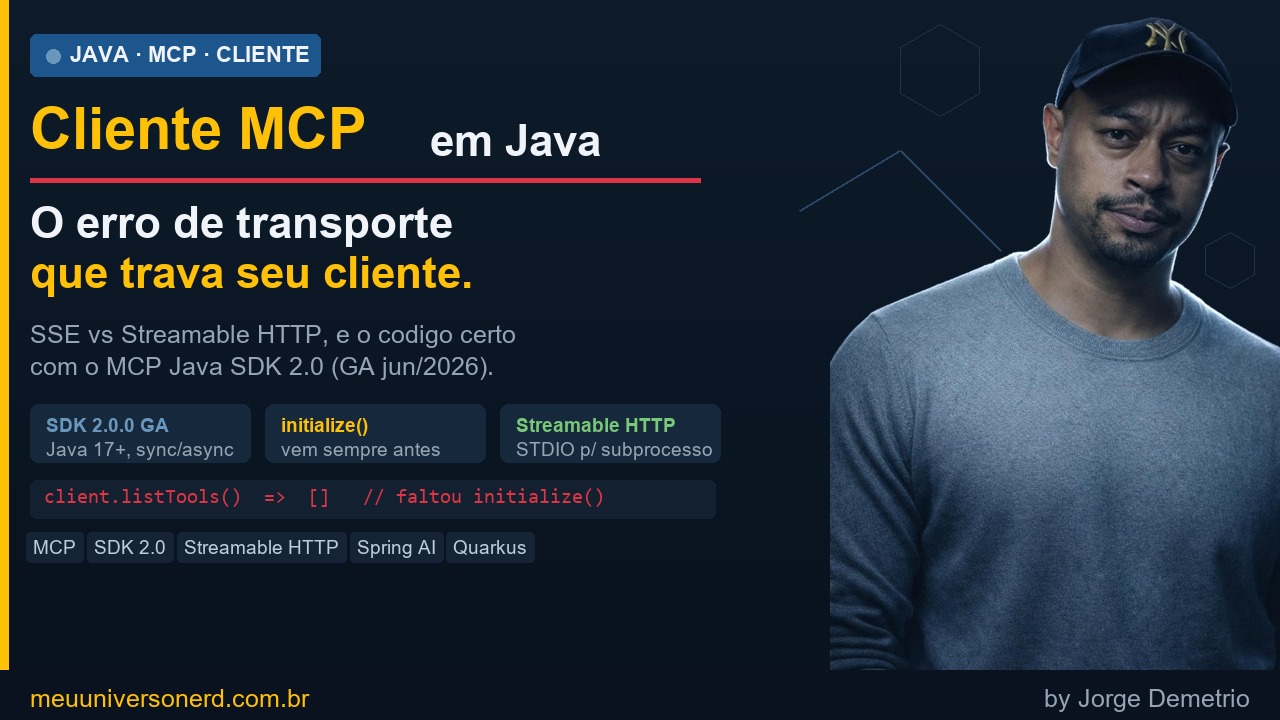
🔌 The transport mistake that breaks your MCP client in Java
You spun up the MCP server, exposed the tools properly, tested with the inspector, and everything was there. Then you wired your Java app as a client and nothing. listTools() returns an empty list, or worse, the call hangs until it times out. You review the server, review it again, and the server is fine. The problem is on the client side, and it usually has a name: the wrong transport.
This is mistake number one for anyone writing an MCP client in Java today. Using legacy SSE against a server that speaks Streamable HTTP, or calling listTools() before initialize(). The connection opens, but no capability is negotiated, and not a single tool shows up. Let us fix this for good, with the right code for each case, using the MCP Java SDK 2.0 that went GA in June.
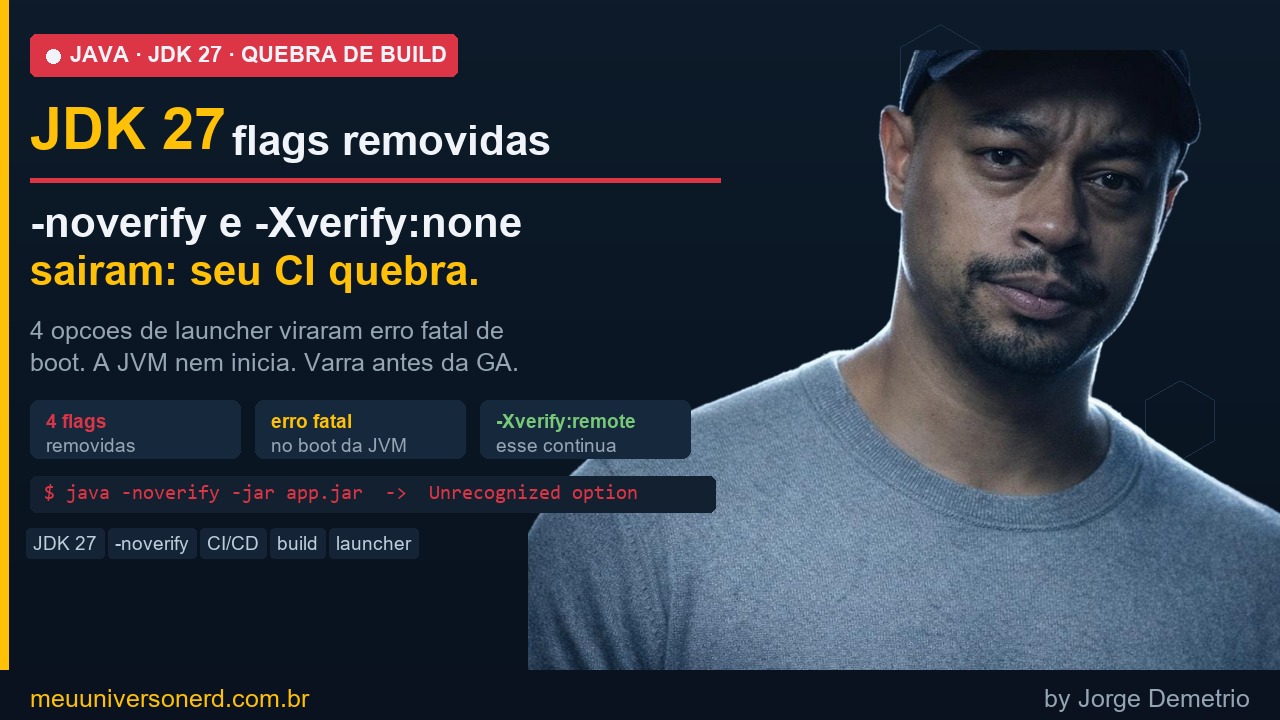
⚙️ JDK 27 Removes -noverify and -Xverify:none: CI Breaks
There is a flag half the CI pipelines out there have carried for years without anyone remembering why: -noverify. Someone added it back in 2017 to "speed up startup" by skipping bytecode verification, the build went green, and nobody touched it again. Until the day you switch the base image to eclipse-temurin:27 and the container simply will not boot. In the logs, one dry line: Unrecognized option: -noverify.
JDK 27 stopped being lenient with four old launcher options: -noverify, -Xverify:none, -noclassgc and -verifyremote. They had been deprecated (with a warning) since Java 13, and now they are a hard error: the JVM will not even start. If one survived in a Dockerfile, in a Surefire argLine or in an IDE run config, the build will stop booting right at upgrade time. Let us see where it hides, how to scan the project first, and how to fix it properly.

⚙️ JDK 27: G1GC Becomes the Default in Your Container
Picture the scene: you only bumped the Docker image tag from eclipse-temurin:26 to eclipse-temurin:27. You did not touch a single line of code, you did not change any JVM flag, you did not edit the pod's requests.cpu. You ship the deploy, grab a coffee, and when you come back that 1 vCPU microservice is burning more CPU and its latency under load started to wobble. The SRE team opens a ticket, the dev team swears nothing changed. And both of them are right.
The culprit has a name: JEP 523, landing in JDK 27, which makes G1GC the default garbage collector in every environment, including the 1 CPU containers that quietly run SerialGC today. JDK 27 entered Rampdown Phase One in June and has GA scheduled for 14 September 2026. So you have a short window to measure your under-provisioned pods before that default shifts underneath them. Let us walk through what changes, how to detect it, and how to pin it properly.

🚨 The "Misantropia" Alert: Was It Really the Civil Defence?
It was nearly midnight on Friday, 19 June 2026, when several phones across Curitiba started going off on their own. This was not just any notification: it was the piercing siren of extreme alerts, the one that fires even with the handset on silent. On the screen, under the header "DEFESA CIVIL", a single word appeared, with no rain, no storm, no shelter instructions: "Misantropia". Everyone who received it described the same thing: a fright, confusion and the sense that something had gone very wrong.
The instant reaction was logical. If the screen says "Defesa Civil", then the Civil Defence system sent it, right? And if it sent a word like that, it must have been breached. That was the reading that raced across social media in the early hours of Saturday (the 20th), with people claiming that "they hacked the government alert system" and even that "every phone in Brazil" had received it. The thing is, the technical story behind that screen is more interesting (and far less apocalyptic) than the panic suggests. As a Tech Leader, I learned early on that the way a system looks rarely proves where it came from, and this case is a textbook example of exactly that.

♻️ Free G1GC in JDK 27: a 1 CPU pod with no code change
There is a garbage collector improvement coming that you get just by bumping the version. In JDK 27 G1GC becomes the default collector in every environment, including that 1 CPU container of yours that today runs SerialGC without anyone asking for it. No new flag, no refactoring a single line of business code.
And the best part: you can prove the difference in one command line. In this article you will understand why so many Java pods are silently on SerialGC today, what JEP 523 changes in practice and how to grab that win even before the JDK 27 GA, scheduled for 14 September 2026.

🧵 I enabled Virtual Threads and production froze: the untold part
Friday afternoon, a traffic spike, and the app you swore would fly after you enabled Virtual Threads just froze. Carriers stuck, requests hanging with no response, the database pool maxed out and throughput dropping instead of climbing. You were sure it was a single flag, right?
Right. Loom did not lie, but turning on Virtual Threads in Java 25 is not config magic. There is a handful of traps nobody mentions in the tutorials, and they only show up at production scale: carrier pinning, the connection pool that becomes the real ceiling, ThreadLocal multiplied by millions, and CPU-bound work disguised as I/O. The good news: JDK 25 already ships JEP 491, which killed the worst of them. Let us walk through all four, with the wrong way and the right way in code, so you do not find out the hard way.

⏰ Spring Boot 3.5 reaches end of life on June 30: migrate first
On 30 June 2026, Spring Boot 3.5 loses OSS support. After that date there are no security patches, no CVE fixes, nothing. And the Spring CVE queue in 2026 was the largest in its history: the patch day on 08 June alone shipped 18 fixes at once. Whoever stays behind runs production with a known hole and no official patch.
The catch is that the path to Spring Boot 4 is not a quiet version bump. It is more than 50 breaking changes: Jackson 3 with a brand new group ID, Spring Security 7 forcing the Lambda DSL, JSpecify turning on null-safety, and Spring AI 1.x simply refusing to start. In this article I hand you the real checklist, with before and after code, so you migrate without discovering each trap the hard way at 2 a.m. during a deploy.

🚀 How to cut 22% of JVM heap without changing a line
There is a way to run the same Java application using far less memory, without refactoring a single service. Most developers never turned this setting on because it was opt-in, hidden behind an experimental flag. In JDK 27 it becomes the default, and whoever understands why gets ahead.
The feature is called Compact Object Headers (JEP 534) and, in the official benchmark, it cuts around 22% of heap and 8% of CPU. Let us look, in practice, at what changes in the header of every object your JVM creates, how to measure that gain in your own code, and in which scenarios it actually pays off.

🔐 Spring Security 7 is here: migrate your filter before EOL
Spring Security 7.0 GA landed in the June 2026 release train alongside Spring Boot 4.0. And there is a detail nobody flagged on your calendar: Spring Boot 3.5 loses OSS support on 30 June 2026. In other words, the migration clock is already ticking, and your SecurityConfig is the first thing that will break the build.
If you already tried to bump a project to Boot 4 and got slapped with a wall of compile errors in the security filter, this one is for you. Let us break down, hands on, everything that changed in Security 7 and build a before and after migration checklist, the way senior engineers do it.
Page 1 of 4