


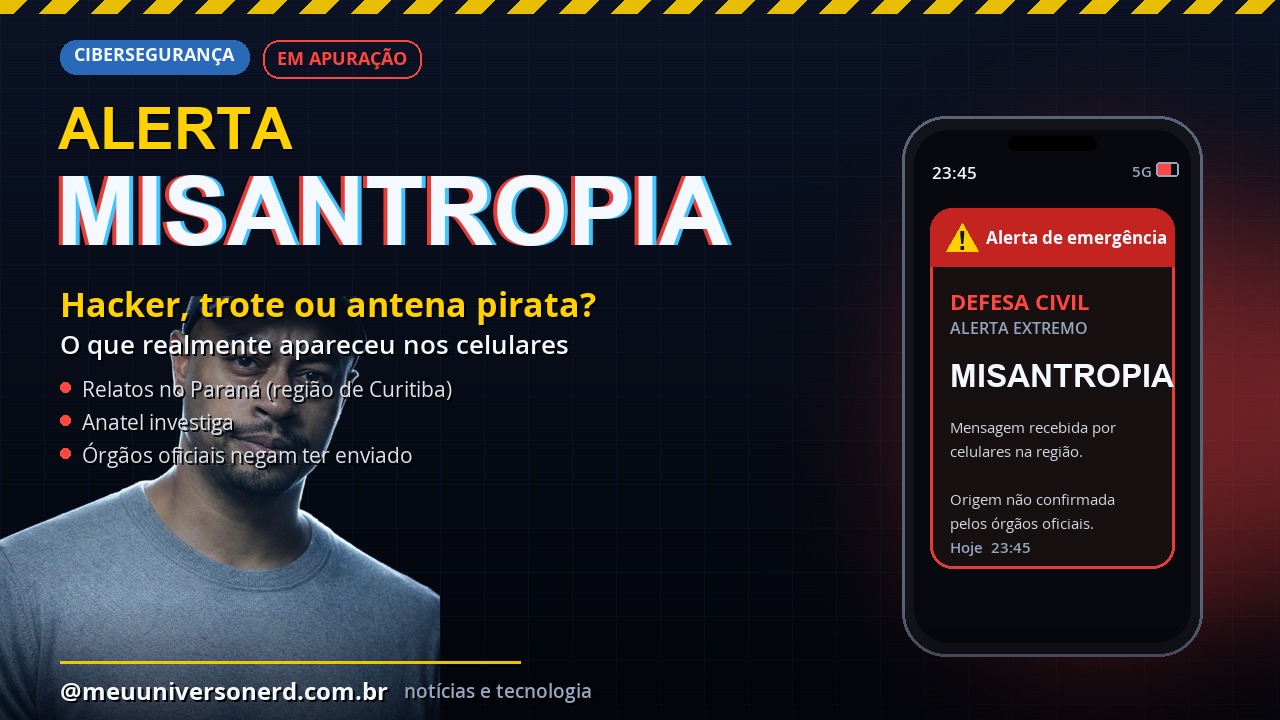
It was nearly midnight on Friday, 19 June 2026, when several phones across Curitiba started going off on their own. This was not just any notification: it was the piercing siren of extreme alerts, the one that fires even with the handset on silent. On the screen, under the header "DEFESA CIVIL", a single word appeared, with no rain, no storm, no shelter instructions: "Misantropia". Everyone who received it described the same thing: a fright, confusion and the sense that something had gone very wrong.
The instant reaction was logical. If the screen says "Defesa Civil", then the Civil Defence system sent it, right? And if it sent a word like that, it must have been breached. That was the reading that raced across social media in the early hours of Saturday (the 20th), with people claiming that "they hacked the government alert system" and even that "every phone in Brazil" had received it. The thing is, the technical story behind that screen is more interesting (and far less apocalyptic) than the panic suggests. As a Tech Leader, I learned early on that the way a system looks rarely proves where it came from, and this case is a textbook example of exactly that.
What happened and what "Misantropia" means
Let us start with the established facts. At around 23:45 on Friday (19/06/2026), residents of Curitiba reported an alert classified as "extreme" carrying the word "Misantropia", accompanied by a siren sound. In the early hours of Saturday, some phones also received an SMS with the same word. Local coverage (Band Paraná, BNews, Band News FM Curitiba) confirmed the episode, and posts on X reproduced the text that appeared on screen: "DEFESA CIVIL! ALERT: MISANTROPIA". By the time the reports went to press, there was no official confirmation of how many handsets were hit or exactly which cities received it, and people online were asking, baffled, "was it only in Curitiba?".
The detail that bothered people most was the absence of any useful information. A real alert tells you the hazard, the area and the instruction ("severe storm, seek shelter"). This one carried only a philosophical concept. Misanthropy comes from the Greek misos (hatred) plus anthropos (humankind), and denotes aversion, contempt or a deep distrust of humanity. Do not confuse it with nihilism, which is broader (the denial of values and meaning). Misanthropy on its own does not imply any wish to exterminate: its most common forms are withdrawal and antisocial behaviour. That is why the word, dropped into an emergency alert, reads like an ambiguous message rather than an operational threat of the "bomb" or "missile" kind. That contrast will matter further on.
Why it looks like it came from the Civil Defence
Before any correction, I need to validate the fright: it is legitimate. The screen really did display "Defesa Civil". The sound really was the official siren, which plays loudly even in silent mode. The people who received it did not "misread" it or "imagine things"; the handset showed exactly that label. So the conclusion that "it came from the Civil Defence" is not foolish, it is the most natural reading in the world given what the screen showed.
The problem is that this natural reading runs into an awkward technical doubt. The "Defesa Civil" label at the top of the message is not a signature of whoever sent it. It is generated by the handset itself, based on the channel the message arrived on. In other words: the phone stamps "Defesa Civil" onto anything that comes in through that emergency channel, without verifying the origin. Hold on to that sentence, because it is the knot at the centre of everything: the screen saying "Defesa Civil" does not prove that the official system was the source.
What is confirmed and what is not yet
This is where the responsible part comes in, and it has two sides. The first is what official sources have already confirmed about this case. The Civil Defence (Defesa Civil) of Paraná denied issuing the alert, in a direct statement the same night: "The alert triggered a few minutes ago did not come from the Defesa Civil of Paraná". The agency stressed that there was no risk situation in Curitiba to justify the warning, and it brought in the National Civil Defence and Anatel. Simepar, the state meteorological service, also ruled out its own system as the origin.
Anatel opened an investigation into the receipt of the messages associated with the Defesa Civil Alerta system. One important distinction is worth making about the reporting: as things stand, the public and detailed confirmation that an alert "did not pass through the technical platform operated by ABR Telecom" appears in the statements relating to cases of the same pattern (the precedents I will detail), not in a dedicated statement naming the "Misantropia" event specifically. In those analogous precedents, Cenad (the National Centre for Risk and Disaster Management) determined that no message left the official tool, and the National Civil Defence clarified that the messages were not sent through IDAP, the Public Alert Dissemination Interface. For the 19/06 case, what we have firmly is the direct denial from the Defesa Civil of Paraná together with Anatel's ongoing investigation, with no conclusive findings published.
Now the second side, which is just as important: what has not been confirmed. Claims circulated that "the national system was hacked" and that "every phone in Brazil" had received it. Both statements need correcting.
- "Every phone in Brazil": technically unlikely. The technology involved (cell broadcast) reaches only the handsets within range of a specific antenna. The reports clustered in Curitiba. By design, this is a localised event, within the radius of a single cell, not a national one.
- "The national system was hacked": not confirmed. As we have seen, the screen showing "Defesa Civil" does not prove an official origin. The agencies deny that alerts of this kind passed through the official chain, and the leading hypothesis (which I will detail) is a rogue base station, not a breach of the national platform. The cause remains under investigation by Anatel, with no conclusion published.
Note that correcting the rumour does not mean dismissing the fright. The screen genuinely said "Defesa Civil", the siren genuinely sounded. What changes is the explanation of the origin, and it points to a different place from the one the panic imagined.
How the official alert system works
To understand why "Misantropia" probably did not come from the national platform, it helps to know how a legitimate alert works. The official Brazilian system is called "Defesa Civil Alerta", coordinated by the National Civil Defence (the Ministry of Regional Integration and Development) together with Anatel, and delivered by the operators Algar, Claro, Tim and Vivo. The content and the timing of the dispatch are the responsibility of the state and municipal Civil Defence agencies; the operators merely transmit what they receive through the platform.
It uses cell broadcast, a technology very different from SMS. While SMS is point to point (it goes to a number), cell broadcast is point to multipoint: the message is not addressed to anyone, it is simply radiated by an antenna, and every compatible handset within range of that antenna receives it. It does not depend on registration, it does not need your number, it works on 4G and 5G networks (on handsets compatible with the 3GPP standard) and it overlays the message on the screen, sounding like a siren even on silent when the level is extreme. As one specialist in the field put it: "if you are within range of that antenna, you are going to get the notification".
The chain of a legitimate alert goes through well-defined stages: the content is set by the Civil Defence agencies, it passes through IDAP, it is reviewed and managed by Cenad, it goes to the technical platform operated by ABR Telecom (the Brazilian Association of Telecommunications Resources) and only then is it transmitted by the operators' antennas. In cases of the same pattern, the official investigation concluded that the irregular message passed through none of these stages.
Underneath, cell broadcast is part of an international standard, the 3GPP's PWS (Public Warning System), which reserves fixed, public channels for each type of alert. These identifiers explain why odd "test" messages sometimes leak out to the public:
Cell broadcast channels (PWS / CMAS - 3GPP TS 23.041)

4370        Presidential / national alert (mandatory, cannot be silenced)
4371-4372   Extreme alert (Extreme - observed / likely)
4373-4378   Severe alert (Severe)
4379        AMBER (missing child / abduction)
4380        Required Monthly Test
4381        CMAS Exercise

Recommended / proposed range for Brazil (Defesa Civil Alerta): 4370 to 4399
Notice channel 4380, the "monthly test". A badly configured test message, left active by mistake, is exactly the sort of thing that produces nonsensical text reaching the public. In the February 2026 precedent, what appeared was a "TEST warning message", that factory boilerplate text that should never go on air. To be transparent: the exact channel "Misantropia" arrived on was not officially disclosed, so slotting the word into the "badly configured test message" category is an inference from the pattern, and not confirmed evidence that it came from channel 4380.
The most likely hypothesis: a rogue antenna
If it was not the official platform, what was it? The prevailing technical explanation, and also that of the specialist who has followed similar cases, is a rogue telecom station coming into operation. In English this is called a rogue base station or fake BTS, and there is even a surveillance-oriented variant, the IMSI catcher. The idea, without turning it into a how-to, is simple to grasp: an unauthorised piece of equipment can transmit on the same cell broadcast channel that the legitimate antennas use.
Claudio Lacerda, development manager at Hugtak (the company that helped create cell broadcast in Paraná), was blunt when analysing the earlier episode, in February 2026: "It is an automatic alert from equipment that is coming into operation". To him, the most likely cause in that case was a configuration error or a lack of knowledge by whoever operates the equipment, leaving a test message active. And he stressed: "it is not an alert issued by the Civil Defence, nor by the operators". His comments were about the precedent, not the current case, but the mechanism he describes applies to the type of event that has now recurred.
This mechanism explains three things that seemed contradictory in the "Misantropia" case:
- Why only some phones picked it up: a handset only adopts a new cell when it loses or weakens its link to the legitimate cell and goes looking for a network. Anyone well served by their operator simply did not migrate. That is why it was not the whole city, let alone the whole country.
- Why the screen still says "Defesa Civil": because the label comes from the channel, not from the sender. An irregular transmitter operating on the emergency channel produces the same "Defesa Civil" screen without ever touching the official platform.
- Why it looked like a test: residual test messages are typical of equipment being switched on and configured.
And it is not the first time. In February 2026, phones in Curitiba received an "extreme alert" with a test message in English. Anatel investigated, the State Civil Defence (Cedec) denied issuing it, Simepar denied it, and the investigation confirmed that nothing had passed through the official platform. Before that, in September 2025, São Paulo lived through an analogous episode with the "TEST warning message A+B" variant. The same "Defesa Civil" label, the same absence of an official origin, the same outcome. By the technical pattern, "Misantropia" fits the same category, which is my own reading of the evidence, not a firm conclusion from the specialist about this specific event.
An honest caveat: there are two readings in the press. One speaks of a "hacker action / irregular signal" (the line Anatel is investigating), the other points to a "station coming into operation, not a hacker" (the specialist). Both agree that it did not pass through the official system, but they differ on the intent: a deliberate attack or a configuration error. So far, neither has been confirmed officially. Treat both as hypotheses.
The angle that matters to people working in IT
This is where the case stops being local news and becomes a security lesson. The root of the problem is architectural, and it is the kind of thing every dev should recognise. The system information blocks that carry the alert (the so-called System Information Blocks, SIB12 on 4G and SIB8 on 5G, per the 3GPP specifications TS 36.331 and TS 38.331) are transmitted by the antenna before and independently of any mutual authentication between antenna and handset. Translated: the alert broadcast has no cryptographic signature that the phone can verify. The handset trusts whoever is radiating the channel.
This is not pub theory. Academic research presented at MobiSys 2019 ("This is Your President Speaking: Spoofing Alerts in 4G LTE Networks") demonstrated the spoofing in practice: with software-defined radio and open-source LTE software, the researchers covered almost an entire 50,000-seat stadium using just four malicious stations of 1 watt each. A later study (Bitsikas and Popper, ACSAC 2022, "You have been warned: Abusing 5G's Warning and Emergency Systems") mapped five practical attacks against PWS on 5G, two of spoofing and three of suppression, with the same dry conclusion: alert messages are not authenticated.
As a Tech Leader, this is the kind of finding I would take straight into a threat-modeling session. It is the classic "trust by channel, not by signature": the system trusts the channel the thing arrived on, rather than proof of who sent it. How many internal APIs have you seen that grant an action just because the request "came from the internal network"? Think of that admin endpoint with no authentication because "only the VPN can reach it", or the service that accepts an X-Internal: true header as if that were identity. It is the same underlying flaw as cell broadcast: trusting the route instead of demanding a verifiable credential. The day someone gets onto the network, or switches on a transmitter on the right channel, the façade collapses. The practical lesson is old and still holds: never trust the apparent sender when the protocol does not authenticate the origin.
And the pattern repeats all over the world, always through some weak link outside the official core:
- Hawaii, 2018: a false ballistic missile alert that lasted 38 minutes and caused panic. Note: it was not a hack, it was human error with a badly designed interface. It serves the most useful argument of all, looking 100% official does not prove a breach.
- USA, 2013: intruders accessed the alert system of at least five broadcasters and transmitted the infamous "zombies" warning. The reason? The factory default password had never been changed.
- Dallas, 2017: all 156 emergency sirens went off for about two hours in the early morning, generating more than 4,400 calls to 911. The cause: a lack of encryption on the siren commands.
- FCC, 2025: hackers hijacked audio equipment left exposed on the internet without protection in order to broadcast false alerts. Again, badly configured equipment at the edge, not the national backbone.
The common thread is always the same: critical alert systems that have historically not authenticated the origin of the message. It is a technical debt going back decades, and the legacy remains vulnerable even as the 3GPP and the GSMA already discuss mitigations such as digitally signing alerts and detecting fake stations.
What to do and what not to do
Picture a shopping-centre analogy. Imagine a tannoy announcement: the "Centre Management" badge that appears on the message is printed by your handset when it recognises the channel, not by whoever spoke into the microphone. If someone plugs a pirate microphone into the same frequency, within range, the announcement comes out with the same "Management" badge even though it is not the management. And only the people inside that building hear it, not the whole city. That is more or less what happened in Curitiba.
With that in mind, here is what to do when faced with an alert like this:
- Do not panic, but do not ignore it by default either. A real rain or flood alert comes with an area, a hazard and an instruction. An alert that carries only a lone word, with no guidance, is suspicious.
- Check official sources. Look at your state Civil Defence profile, the city council website and local news outlets before spreading it. That is exactly how it became known that "Misantropia" was not official.
- Be doubly careful with scams that mimic alerts. This specific case contained no link and asked for no data, but the "urgent alert" logic is classic phishing ammunition. A legitimate emergency alert never asks for a password, a payment or a click on a link.
- Understand what the message does (and does not do) on the handset. The cell broadcast message itself installs nothing, steals no data and grants no access to your phone. It is only a radiated text that is displayed. What deserves attention is not the message but the irregular station behind it, which is precisely what Anatel is investigating (clandestine equipment may have capabilities that go beyond displaying a piece of text).
- Report it. Anatel advises logging the case through the Anatel Consumidor app, via the 1331 hotline (free, weekdays from 08:00 to 20:00) or by WhatsApp, giving the date, time, operator and approximate location of receipt. This kind of report is what helps triangulate the position of the antenna and locate the source of the irregular signal, so reporting is not bureaucracy, it is part of the investigation.
Conclusion
The "Misantropia" case is one of those that look frightening on the surface and turn into a lesson once you look underneath. The screen said "Defesa Civil" and the siren sounded; the fright was real and deserved. But "looking official" and "being official" are different things, and the technical evidence points to a localised signal, probably from a rogue station, and not to a breach of the national system that would send a message to the whole of Brazil. Anatel is investigating, and for now that is what we know honestly.
- The screen is not proof of origin. The "Defesa Civil" label comes from the channel the handset recognises, not from a signature of whoever sent it.
- Cell broadcast is local, not national. By design, it reaches the radius of a single antenna. "Every phone in Brazil" is technically impossible for one signal.
- The underlying flaw is the lack of authentication. Alert systems trust the channel, not the sender. It is a security lesson that reaches far beyond the phone.
And you, did you receive the "Misantropia" alert, or do you know someone who did? Which city and neighbourhood was it in? Tell us in the comments how the experience went, and whether you, in IT or not, had ever stopped to think that an emergency alert can be born outside the official system. Let us gather the reports and understand this case better.
Also read our related content on the security pitfall of running a Spring Config Server in a pod with a shared volume, on the Spring Security release train and its CVEs and on migrating to Spring Security 7. To dig into the official sources, see the Defesa Civil Alerta page on gov.br and the Convergência Digital coverage of Anatel's investigation.